Showing posts with label gratitude. Show all posts

Thursday, April 21, 2016

The Aquifer


As the Water enters the surface it then
starts a very long slow j
ourney through
to the Aquifer. This can take centuries
to 
reach the lower depths. –boreholeaquifer.co.uk


Beloved, thou art love’s unfathomable
aquifer, twisting up to revelation 
through a fracture in the rock – a bright 
spring churning mist, emerging as a 
fountain from a hidden source, bold, 
bountiful, and offering itself without 
apology where all around is inhospitable, 
a muscle flexed for centuries and on,
until the next eruption.

Wednesday, November 25, 2015

Poplar Gratitude

http://kkimagery.com/last-leaf-this-year/last-leaf-on-a-tree/


Gratitude poem of the day #3, five lines in iambic pentameter, 11/25/2015

POPLAR GRATITUDE


A crooked tree, a naked branch--a leaf?
How does it stay attached, this russet thing
with specks of green? Tenacity, perhaps?
Impertinence?  A yes to winter’s no?
Or newly grown and confident of spring....

—by Mary Campbell

Tuesday, November 24, 2015

Labrador Gratitude


Gratitude poem of the day #2, five lines in iambic pentameter, 11/24/2015
Photos, 1997?, Amos (Lab-Golden mix) & Dani Dog, parents of 10 pups
*
I have cohabited with Labradors—
enthusiasm, joy, affection packed
in white and yellow fur—whose appetite
for human hugs and Frisbee games was matched,
or nearly so, by that for hamburger.

--by Mary Campbell


Monday, November 23, 2015

Caffeine Gratitude

HAPPY THANKSGIVING, EVERYONE! This week I'm challenging myself to write each morning a gratitude poem of five lines in iambic pentameter. 
Here's no. 1, for 11/23/2015:
------------------------------

CAFFEINE GRATITUDE

My morning coffee—yesterday’s, I must 
confess, reheated in the microwave—
is less a beverage than a simple, cheap
indulgence, plus a timely tweet from God:
“A brief reminder: Bitter can be sweet.”

Thursday, May 29, 2014

No Complaints

Sunshine and Shadow, Winslow Homer, 1872

SUNNY, CHANCE OF SCATTERED STORMS


O Memory of mine, if some trifling irritation should
happen to at any time arise and try to shape itself into
a shadow something like complaining… if, perhaps, my
pillow is too hard or soft or otherwise refuses to
cooperate with the odd shape of my head... or it
occurs to me to wonder,
Did I forget to lock the door?
and I, grumbling, get out of bed and stumble twenty
feet to check — the door indeed
is locked, and I am
cross about the wasted effort —

Remind me gently, Memory, about the day when I
believed I had nowhere to stay... and then about my
lying in the dark on cold faux marble tile in hostile
territory, as it seemed, behind a door marked “Detox
Intake”... about the racing heart, the inward violence,
despair thrashing crazily in a bottomless, vast lake of
peace that maddeningly would not swallow it —
serenity that would not yield....

And, Memory, allow me never to entirely forget the
brisk, efficient kindness of the human hands that
brought a blanket; tired eyes yet bright with hope that
read my vital signs; exhausted voices — gravelly with
having been pressed into shouting for ten-and-one
half-going-on-eleven brutal hours in a facility both
understaffed and overcrowded — that still could ask
with genuine compassion,
Are you having thoughts of
suicide?
Remind me, Memory, of that sudden and
eternal and surprising certainty: I didn’t want to die.

And then release me, Memory of mine, from history
back into life, the bliss that is this very minute, warm
and glorious with sunlight and the possibility,
however slight, of thunderstorms.


Saturday, January 28, 2012

On a summer afternoon...

Claude Monet, Water Lilies and Clouds, 1903

YOU AND ME IN A TREE

Would you like to live in a tree, you and
me? Like a wee set of robins in a sweet
little nest at the tippy-tippy top of a great,
mighty tree, oh, how high up in the air
we would be, and how very, very far
we could see, and how positively lovely
life would be if we lived in a tree!

As for me, I like cottonwoods. They're not
the least bit shy. They tell such delightful
secrets in a whisper that you're meant to
understand. When gentle breezes blow,
the sly leaves kiss and tell, and the limbs
brush hands... so graceful to behold are
they, such simple pleasure in the harmony
they make. I love to wake up just when
dawn begins to turn the leaves from gray
to gold, one after one, for every star that
disappears above.

There is a happiness in their activity, no
matter if the day is cold or hot, dry or
steamy. Ice and snow don't seem to hold
them back from their festivities. I see them
dancing when the wind is wild, and never
mind the rain. They celebrate the clouds
that tumble in and hide the sun -- a sign to
let the fun begin. They wiggle, waggle,
jump and spin and somersault; their
branches, ever dignified, sedately bend
this way and that, as proper as a minuet--
except the young stems at the top, which
whip about as if to slice the very sky.

I watch them from my window and
confess myself relieved that we don’t
need to live, just then, out in a tree, do
you and me. But when the last cloud
scurries off and I see robins hopping on
their nimble legs around the yard -- the
ground is thick with worms just begging
to be found -- and all the normal goings-
on of summer afternoons pick up where
they left off -- the buzzing of the honey-
bees, the opening of peonies... lawns
being mowed and gardens hoed and fat
old lazy cats meandering in search of
easy pickings, flattening to scratch their
backs wherever there's a gap between the
sidewalk and the pickets of a fence... the
planet seems to thrum in deep contentment,
and I sense the tree is wanting me to share
its comfort and felicity.

I see the very spot, just right for you and me,
not more than four feet up the trunk. It is
the perfect size for us, a book for each, a
half-a-dozen cookies and a few ripe, juicy
peaches. So we climb and sit and eat and
read and say hello occasionally to people
passing by, who smile and nod and think
it isn't odd, not in the least, to see us side by
side up in the tree, for certainly they're
used to such a view by now, and if they
shake their heads and think of you and me
as "strange old dears," it's with affection and,
perhaps, a bit of awe within the thought.
There's not a soul around who doesn't know
that this has been our favorite spot for more
than sixty years.


Children's Song Version

Would you like to live in a cottonwood tree,
You and me, you and me, you and me?
We could build a nest—oh, how merry we would be,
For a nest up in a tree must be heavenly.

But can you fly?
     Can I fly?
Can you fly away
To a place that's warm and dry?
When the wind blows cold?
When it rains or snows?
Where would we go, you and I?

We can have our tea in a tree when it's dry,
Not a cloud in the sky—if it rains, we can't fly away.
If it starts to pour, we can always go indoors
Where the cookies and the attic will be warm.

Let the robins gobble all the worms!
Bugs and thunderstorms are for the birds.


Claude Monet, 1840-1926

born in Paris, 1840


Renoir, Claude Monet
Reading,
1872
Claude Monet was and still is one of the most famous artists in the world. He painted for money, but he also liked to paint for the joy of it. Most of his paintings are scenes of water or nature. This is because he liked the way the outdoors looked in different seasons, in different light. He was one of the painters who invented Impressionism — a style of painting in which artists use dabs of color to show how a scene or object looks and how the light falls.


Monet liked to paint water. He liked the way colors reflected in the water. Boats, oceans, and lakes were some of his favorite subjects. He liked water so much that he fixed up a boat as a floating studio. Monet kept paints, brushes, canvas, and drawing supplies on his boat. 

In school, Monet didn't do very well. He said, "School seemed like a prison and I could never bear to stay there, especially when the sunshine beckoned and the sea was smooth." He always drew funny caricatures of his teachers. He got in trouble for his drawings, but he became very good at them.


At the age of nineteen, Claude had to join the army. He was sent to Algeria, a country in northern Africa. He liked the way the bright clear light of Algeria lit the sky, and  how the shadows moved when the wind blew. A year later Claude became very ill with typhoid fever and returned to France.


An artist called Eugene Boudin liked Monet's work. He told Monet that he should paint outside. "That way you can feel what you paint." Monet DID paint outdoors, but usually things would stick to the wet paint—sand, bits of rock, leaves, and other natural litter.


Monet made money by selling his paintings in art museums, including the great Salon in Paris. One painting that the Salon did not accept was The Women in the Garden (1867-1868). A model for the painting, Camille Concieux, would become his wife in 1870. They had two sons, Jean and Michel, before Camille died of tuberculosis in 1879.


The Women in the Garden
Monet and other artists began painting in a way that showed how pretty objects looked when the sunlight reflected on them. A newspaperman called these artists "Impressionists" after Monet's painting Impression: Sunrise. The newspaperman actually didn't care for the style, thinking that Impressionist art looked “unfinished.”


Often, Monet painted many pictures of the same things, in different seasons and at different times of the day. He tried to make colors, shadows, and light in his paintings appear as real as possible. 


Monet’s painting had made him rich, and in the 1880s he moved his family to a large farmhouse at Giverny. His second wife, Alice, died in 1911 and his elder son, Jean (married to Alice's daughter Blanche), died in 1914. It was Blanche who cared for him in his old age, as he was going blind. But he continued to paint until he died in 1926 at the age of 86. 

He spent the last ten years of his life painting scenes of his water garden. "What I need most of all are flowers, always, always," he said. These paintings are among his most beautiful and famous. Some of them are over forty feet wide. Among these late paintings are Water Lilies, Panel of Water Lily Decorations, Snow at Argenteuil, and Venice--the Grand Canal.

Sources: Wikipedia and library.thinkquest.org


Wednesday, November 23, 2011

Playing God


Forgiven

I wondered at another's strength
begrudged her victory
despite the cost
and was ashamed
of being not as strong

I contemplated Jesus on the cross
while I forgot the resurrection
and the lessons: gratitude, compassion
and I walked away from grace, ashamed
of clinging to my body and not
making of it such an offering

I shunned companionship, ashamed
of wanting it—a friend, an intimate
would be too soft a pillow for a
head that ought to bear a crown
of thorns instead—and with such cruel
thoughts, in solitude, I clawed my spirit
even as I prayed for God to spare me
suffering and loss

Sunday, June 5, 2011

The Land of In-Between


Claude Monet, Au Parc Monceau

After an Early Supper with Friends
June 4, 2011

This is the time when shadows start to blend; the
day is not quite ended, nor has evening quite
begun. There is a kind of hush — no chorus
sounds; each noise is singular: the scrape of
Papa’s chair, a pair of doves emboldened to
converse, the bleating of a lamb. This moment
seems to stretch, the earth is sluggish in its
spinning. Is the sun reluctant to surrender at the
hour appointed? Is our star just now
Claude Monet, Evening at Argenteuil
undisciplined and truculent?

Something holds its breath; we hardly notice even
as we cease activity and rest upon a hammock
strung between the first peal and the last one of
the village clock; and then we slide upon a great
collective sigh that’s part contentment, part regret
at being not allowed to stay here in this mystic
land of in-between, this fissure in the continuity of
day and evening

Saturday, April 30, 2011

Being a Seed


I am a seed that swells with earth and water.
Though my shell is hard enough to break your
teeth on, time and melting snow accomplish what
exertion never could. I am a seed that would do
nothing but to heed my longing, ancient, deep,
beyond my understanding.

I am a seed that has no memory of being planted
in this fertile land. Safe and secure, I hug my
sturdy skin around me, grateful in my tiny
burrow when the winds with frigid fury wail an
inch, no more, above. Protected and content, I rest
until awakened by the thaw that never fails to
come in season. Buried, waiting, I can feel the
change in how the planet breathes, with each
unhurried exhalation warmer till the snow
recedes, the stony ground relents and softens.
Only then do I expend the energy I hoarded
through the winter... only when the elements
cooperate and not before. I neither labor nor
procrastinate, nor do I push against the soil... it
parts for me if I am patient, just as if it were the
Sea of Reeds and I were Moses bound for Canaan.

I am a seed and more... a dainty-leaved acacia,
lavish hyacinth, a lilac bush, a rose... What do I
care, now that I know the tender sweetness of the
sunwashed air at evening here beside an age-old
forest? I have seen the jeweled curtain of the night
sky and observed as one by one the stars winked
out like servants, dutiful and self-effacing in the
slow euphoria of dawn. For certain, the Almighty
is creating me as beautiful, as useful, and as
strong.

Wednesday, April 27, 2011

Moms in Hell

Mom collected and sold 18th-century American antiques. She would have loved this 1868 Winslow Homer,
Artists Sketching in the White Mountains

MOVING PICTURE


I once had in my home
a Hoosier Cupboard much like this
 God, I thank you for the mom you lent me to, and for
too short a time it sometimes seems... much more I
could have learned from her about serenity, I find,
now that I know what she went through. Well. What
an education from my infancy, to see her resurrected
from her private hell, and learn to celebrate her triumph.

Oh, I hated her and spurned her hugs and turned to
Dad for love instead. I only knew that she had left
and when she stayed she drank too much and stank
of wine and cigarettes and that the house was always
an embarrassment (I’d yet to learn that life itself is
messy). Well — except my siblings’ rooms and
Daddy’s dresser — little islands gleaming in their
tidiness amid the chaos that my mother left for Alma
to bring order out of, goddess that she was, on
Tuesdays, nine to five, and Friday afternoons.

Dear God, I praise you for this mother and the love
she kept in escrow for me when I came of age, and
that I did so while she lived; I thank you that we
had those blissful years of friendship. When I carried
Marian, I asked her, I remember, “What if I don’t love
my baby?” (I was, after all, the youngest. What could
I know of an infant’s sweet compelling winsomeness?
I’d been unlovable enough myself, unkind, to punish
her, as if she didn't have her share and more of
torment.) Well, she said. I promise, you would walk
through fire — no, you would run through hell to save
your child. And so I have, for all of them. And so I
would again. A mother suffers every pang her children
feel, and doubly, till she learns surrender.


Mom had a corner pie cupboard filled with this type of pottery, called "flow blue,"
which originated in 18th-century Staffordshire, England

Father-Mother, thank you for the scent of Shalimar that
sometimes drifts by... through the window... from the
sky. And thank you for the memories, which are not
fixed like pictures in a book; they are alive, as she is,
very near, I often sense. Well. I can see her now, the
way she’d sit, one leg tucked under her, in tennies on
her favorite chair, and how I wish I hadn’t sold it
years ago to pay the rent. She would have told me to,

Mom's chair, or close enough. This one is from
the website http://www.efi-costarica.com/. It's a
late-19th-century Eastlake; Mom's was
upholstered in dark blue veltet
 however. No regrets, then. Now she sits on air.

Creator, thank you for my funny mom, who would
have looked around, as I do now, at papers, manuscripts, and
laundry, at the baskets full of unrelated stuff and sundries,
at the dishes, pots, and pans; and she would not have been
dismayed. Well. She had Dad, I have three cats. I
can’t say Dad was much more help than they are, not
indoors, at any rate, although he kept the bills paid,
did the yard, and loved us all inordinately, as fathers
must. He didn’t dust, however, nor did Mom, except
for company, and that, once I had learned how wise
she was, how rare and good, was fine with me.

Saturday, April 23, 2011

Blackout

For Cheryl Richardson
Sunrise from Pike's Peak

I GAVE UP ELECTRICITY FOR LENT

I gave up electricity for Lent. Naturally it was unintentional — an accidental blackout due to lack of funds
and then I just forgot because my mind was occupied with, oh, who knows at any given time? ...with dust
motes, maybe, bouncing slat to slat and settling at last upon a miniblind ...with all the kinds of clouds there
are, the stacking-up ones that portend a storm, the cotton puffs, the ones that roil, and the flat, still, formless,
suffocating ceiling that can make you feel bereft, make you forget the sun is shining warm and bright above,
and don’t you love it when the jet you’re in glides up and up through mist into the blue?

Well, unintentional or not, one does the best one can in each and every circumstance. Life gives you
peaches, and what’s that about, except a chance to bake a pie, perhaps a cobbler or a tart instead... and for
a heady, hungry moment you forget your oven is, of course, electric. Damn its cold and unresponsive coils to hell!

I had a fascinating conversation with a nun a dozen years ago and never have forgotten one fine bit of
wisdom she dispensed: Thank God for everything, she said, the flat tire and the lightning strike that split the tree that
sent the limb adrift to smash the roof of your garage... and, I’m interpolating here, the power outage.

Sound advice, I’ve always thought, and meant to follow it, but first I spent an hour being sorry for myself,
and another thirty minutes self-berating. Then I basked in gratitude, not feeling it at first, just doing it, just
glancing nervously at my unruly cache of blessings, finding it a mess as I expected. Focus, focus, said I to
myself, and I began to separate the chaff and wheat and whatnot. Sooner than I had imagined, I had five or
six neat mounds of reasons to be happy. I began with you and then I took a nap.

My family and friends are nothing if not present, steady flames of energy and some of it spent loving me
and isn’t that miraculous, considering that most of what I give back is intangible — sporadic words and
thankful little hymns I dedicate to you.

And every night of this now sacred interval of dark I lit three candles — every night my private trinity of
them — one for the bathroom, one to warm my coffee cup (Elaine made coffee for me and my air pot kept it
nice and tepid), and the third for prayer and meditation and just watching it and getting lost in its forever-changing
flame.

Every night I prayed for you, and if it was because I’d nothing else to do, no music from the Internet to listen
to, it was a fine and satisfying way to spend my time nevertheless. With not as much success I tried to trim my hair by candlelight — my
bangs were hanging in my eyes in clumps — and now I look as if a two-year-old had had her way with scissors while I
dozed and there are spots of frizz and holes where hair once was, pink shiny scalp as if I had some kind of
parasite.

I swept the dust off dresser tops and desks and such with one of those green fuzzy things like hair on trolls
we used to buy. I tried to heat a bowl of oatmeal with my coffee candle, but the mixture never did congeal,
so I said, “Thank you, God, for sustenance” before I plunged into my meal of Crystal Lite and little cookies
shaped like tigers, lions, pigs and goats and antelopes and elephants... and then I chased it with a swig or two
of chocolate syrup. Took a tiny nap and thought while drifting off I’d better pitch the half-a-catfish turning
lethal in the freezer.

My kitties kept me warm. Tim placed a paw across my abdomen and purred with absolutely undisturbed
contentment. Henry buried his entire head and twitched his whiskers in my armpit, and it tickled — wicked
Henry, so aloof so long until he claimed me as his closest friend. Miles likes to lick my skin, whatever is exposed —
my toes, this time.

I rose. I stretched, I folded clothes. I swept the kitchen floor and washed the dishes, made a mental note to
take the catfish and the peas out of the freezer and to set a pan of vinegar in there to neutralize the odor. If
I started to get bored, I meditated more, remembering as Kevin Farmer teaches to include the blues if they
intruded, as they did occasionally. I contemplated poverty but I could not sustain the thought of it. When
you’re encased in cats, you feel how near abundance is, just like the sun, exactly like the sun above the black
and stormy sky. And when my power is restored — tonight or in a day or two — I’ll try to fix or
else disguise the defects in my coif... and I will hope to carry out of this experience, this accidental Lenten
sacrifice, the gratitude for simply life, sustained by energy that doesn’t flow on metal wires, that kindles its
own fires and makes a meager meal of purple water and a lump of gritty crackers more or less delicious,
manna, if you please, from heaven on a cracked Fiesta dish, and— oh, dear God, the catfish and the peas!


LEAD ME ON

On Easter, if you celebrate
no other way, at least do
this: Go out into the young
spring day, and if it rains, it
rains. Engage your senses. See
abundance in the leaves about
to open naturally... relaxed, they
do not strain or struggle in
their work, though it is necessary
to the universe. Now hear
the song that's being sung, the
constant music in the air, and feel
the breeze that strokes your face
and stirs your hair. Breathe deeply of
this sacred space, and smell the fertile
soil, the apple blossoms, promises of
lush red fruit in autumn. Snap a petal
off a daffodil—soft as a mother's cheek
and velvety. Now stretch your arms
toward heaven, if you dare, and
let this be your prayer:
Creator,
thank you for my life, which
you make fresh and new, erasing
my mistakes repented and
my sinfulness. The price was
paid, and I, Creator, I accept
your precious gift of innocence.
Unmeriting, I claim the grace
you offer— have indeed beseeched
me in my heart to take so that the
sacrifice will not be wasted and the
deed made meaningless. This day,
the next, I start at the beginning.
I am spring today— the
fertile earth, the bursting bright
green infant leaves, the redbirds
trilling winsome carols long before the
dawn. I am released. This prayer affirms
me clean and pure as at my birth.
And in my freedom I surrender, Source
of Love, Almighty Spirit, to your
wise direction, leading to my highest
good, and ask for your protection
in my journey. I am sure of
nothing but your great and loving
presence, your eternal patience with
my aimless wandering. Now lead me on.
O lead me, Father-Mother, lead us all
in glory to our perfect destination.
May it be thus. Amen.
Luc Viatour GFDL/CC

Saturday, February 26, 2011

Terrified of Bliss


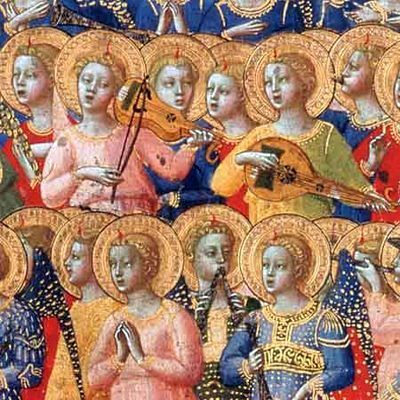
Angels with the Blessed Virgin -- Botticelli

 A PRAYER TO MY ANGELS


O ye angels, fly to me
and lift me out to sea, above
the waves that rest but never sleep
while there is work undone.
Perhaps the sea’s an angel too;
it has the timeless job to do
of cleansing this untidy earth
and birthing it anew.


Galatea — Raphael
O ye angels, carry me
upon thy wings, a brief escape,
then stay a bit, I beg of thee,
and help me concentrate.
My mind, it likes to creep away;
in vain I order it to stay
and serve the purpose I’m about;
but it’s gone out to play.


O ye angels, lend thy power
to my responsibilities;
I seek the effort of an hour
before my labors cease.
I have no gold to save or spend,
nor do I want thine, angel friends;
instead I need thine energy
when lethargy begins.


At last, ye angels, when the task
is finished and the cottage neat,
I’ll have but one more boon to ask:
my prayers lay at God’s feet.


THE JOY OF THE LIGHT OF GOD


Alleluias rolled from the east

What are we waiting for? Why do we
hesitate? For here and plain as dawn
when every demon of the night has
fled, we see the joy of the light
of God. We need only step out of
the mist—no odyssey have we
to undertake or foe pursue, no
secrets to discover. There is only love to
be accepted, met with gratitude... now
only happiness to claim. Anxiety, regret
and shame—these were the evils
that evaporated as we watched. No
sooner were they gone than Alleluias
sweet and strong rolled from the east
and would have swept us off our feet
and carried us aloft, had we not clung
to earth, so terrified of bliss we are if it
should cost surrender of the shreds
of skin we still identify as “us.” The
lungs, the bones, contorted hands
and feet; the pain, disease, decay are
us, we say? As if God meant us to be
temporary, having used up our
allotted days, too old and slow to
overtake the measured plodding step
of entropy. But we are woven of a
better fabric, one that grows more
durable with wear and time and testing.
Still we hesitate, though faith has been
replaced by certainty.

St. Francis of Assisi with Al Kamil -- 15th century
With reluctance mixed with fascination
do we draw a little nearer, inches at a time.
We cringe when light falls full upon us
and the unfamiliar frightens us. We are
accustomed to the cold, the dark, and sink
into delirium as we might fall upon a rotting
pallet in a beggar’s squalid inn, when our
soul’s comfort and security, clarity of sight,
the soundness of the body, heart repaired
and spirit whole are certain, not mysterious
as once they were, remote, the whisper
of a promise too ethereal to tempt the
desperate, the wanderers in need of solid
benefits, of food and shelter. Isn’t it more
sensible to hesitate? God isn’t going anywhere.


 LOVE STICKS

Love comes later, in the wake of pain,
like rescue after piracy. Sometimes the
buccaneers escape with their ill-gotten
gains and damn the bodies and the sailors
who survived. These are forgotten or
outshone by treasure seized according to the
code of honor thieves and brigands go by.
Guardian angels

I have love. Sometimes I keep it chained but it escapes eventually. The chase is
futile. I pursue it anyway, at
least to see where it alights. I’ve little
hope of catching it but I can sabotage
attachment anyway until it flickers
out of sight.


Both love and I know which of us is wiser,
stronger, and more patient. Truth be told,
I’d really rather give the game up, let love
lead, but ego won’t permit me to, not
yet at any rate, though soon, I’ll wager.
It feeds on my weakness, and I’m weary
now, as one becomes from filibustering.
Its loyalty is oddly given, not bestowed where I would choose. It forms unsuitable
alliances and clings tenaciously. I
win, it says and flashes me a saucy
grin, and so do you. It’s only face you
lose. I’ll get it back to you.


Love is like a tireless suitor, one who
could have gone away for good but stays to
tease me, plays a waiting game. I
wonder if it plans to catch me up in
some transgression. Hardly likely, as it’s
had a million chances. Still it sticks as if to
lure me, which is curious. It surely knows
I don’t deserve it.