 |
| Eggshell potted plants, bhg.com |
DAWN AT MIDDAY
If I were going to live here – and to
all appearances,
I was, the heap of luggage at my feet
attesting to
the fact – then there would need to be a
very lot of
plants, I thought. In my experience, a
few lush,
hardy pothos were the ticket: instant
ambience and
simple propagation – cuttings in a jar
of water,
nothing to it. Pothos thrive that way,
requiring
hardly any light and not a bit of fuss. I
set them side
by side or cluster them in corners.
Right away they
are the best of friends. You see it in
the sweet (and
shy at the beginning) twining of their
stems. They
show up better, too, in bunches. Shiny
leaves and
sturdy, twisty vines attract the eye and
give a dusky,
timid space vitality. Thus, with this
simple show of

I spot a sunny window and I feel like it’s my
birthday. Every home must have a few, to
ward off
melancholy. Dark moods brighten in the
company
of pots of jaunty herbs along the narrow
boundary
between inside and out. To bridge the separation,
hang a pothos overhead and dust the
leaves with
regularity. Be sure to note the time of
day when
first the bravest rays begin to brush the
foliage,
much the way a mother strokes her baby’s
face...
and let the moment be a regular
appointment so
you don’t forget to stop and sit and
watch
habitually, in awe of what you’re
witnessing, the

Try not to think too much about the photosynthesis
that’s going on. It fascinates, but this
is an
exchange of love between the earth and
sky you
look upon, and the display is brief... a
micro-dawn, a
silent prayer that can be only now
observed. One
cannot help but worship then the Power
that upon
the first encounter stirred a need to
place green,
growing things upon a kind of altar. One
might be
alone, but here, by grace and some
strange
alchemy, is home.
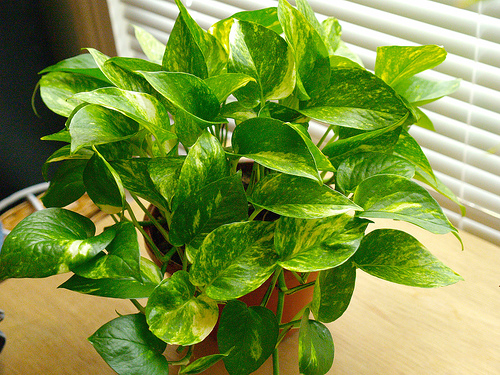
Pothos (rhymes with MAH
dose) is a popular houseplant for a number of excellent reasons. Officially Epipremnum aureum (E. aureum), pothos was once
classified within the genus Pothos. Imagine that! Pothos is not
related to the philodendron though it is often mislabeled as such.
Other
names for pothos are
·
golden pothos
·
money plant
·
silver vine
·
centipede tongavine (Don’t you love how those words roll off the
tongue?)
·
devil’s ivy
·
Solomon Islands ivy
NOT A SALAD INGREDIENT.
Practically the only downside to pothos is toxicity to people,
especially small children, and to pets. I checked several sources and found no
mention of its ever having been fatal. Chewed or eaten, pothos can, however,
cause “oral irritation, vomiting, and difficulty swallowing” (Wikipedia). North
Carolina State University plant scientists warn that ingesting any part of the pothos in large amounts “causes severe pain in
the mouth.”
LET’S CLEAR THE AIR. Pothos is one of the best “air-cleaning” houseplants,
which are surprisingly effective in absorbing common indoor pollutants,
including carbon dioxide and volatile organic compounds (trichloroethylene,
benzene, toluene, xylene, and formaldehyde, for example). Plants won’t help
much, if at all, with tobacco smoke or dust.
There was a time when I
aggressively sought out information about harmful stuff. As a mother of young
children, I was hyperprotective until I figured out that, although obsessively
scrubbing potatoes might make them safer to eat, it was making me overly
earnest and tense, a fact not lost upon the potatoes, which tasted bitter as a
consequence. Food, I discovered, has more flavor when it’s handled sensibly and
there is laughter in the room. I adopted the maxim that, in terms of household
health practices, laughing is better than scrubbing.
If you’re a person who likes
to know which ordinary substances and objects are pumping toxins into your
living space, the answer appears to be “most of them”:
- particleboard, pressed-wood items, carpet backing, adhesive binders for floor coverings, insulation
- wrinkle-resisters, water-repellents, fire-retardants, cleaning solutions
- plastics, found everywhere but more problematic in tightly sealed new construction, where synthetic carpeting, laminated counters, and plastic-coated wallpaper are standards
- many types of ink, paint, lacquer, varnish, adhesives, oil
- paper products (including grocery bags, tissues, paper towels)
- gasoline stored in basement or garage; vehicle-exhaust fumes from outside
For effective
indoor-pollution control, allow one houseplant per 100 square feet. To prevent
mold, don’t overwater and do provide adequate air circulation and ventilation.


